
by Alexa Button, Climate Change Resiliency Intern
The term “minnow” is often used broadly to refer to any small fish, however minnows range from small to large freshwater fish belonging to the order Cypriniformes and the families Cyprinidae and Leuciscidae (Coad, 2015; Conservation Commission of Missouri, 2025). However most minnows in Canada, including the at risk Pugnose Shiner, Bridle Shiner and Cultip Minnow, belong to the “true” minnow family, Leuciscidae, within the order of Cypriniformes. Familiar names in this family include shiners, chubs, stonerollers, and dace (Conservation Commission of Missouri, 2025). Minnows play an ecologically important role in ecosystem functioning, facilitating the transport of nutrients between the aquatic and terrestrial food chains. While minnows eat plants, insects and other small organisms, they are then eaten by larger aquatic and terrestrial animals, namely fish, frogs, snakes, turtles, birds and mammals (Conservation Commission of Missouri, 2025; Watt & Pitcher, 2025). Minnows are some of the most diverse freshwater species, and based on their specific habitat requirements and role in the ecosystem, are an indicator of ecosystem health (Watt & Pitcher, 2025; Fisheries and Oceans Canada, 2024). Despite the ecological importance of minnows, many are still under threat, with 70% of North American species on the International Union for Conservation of Nature (IUCN) red list (Watt & Pitcher, 2025). In Canada specifically, threatened and of special concern minnow species, the Pugnose Shiner, Bridle Shiner and Cutlip Minnow, need your help.
The Pugnose Shiner is a threatened small silvery minnow with a lateral black stripe, and pale yellow tints on its back (Fisheries and Oceans Canada, 2024). Habitat includes high quality shallow areas of lakes or slow moving rivers with an abundance of submerged aquatic vegetation, as their diet consists of filamentous green algae (Fisheries and Oceans Canada, 2024). This species is distributed across the southern drainage of Lake Huron, Lake St. Clair, Lake Erie, Lake Ontario/St. Lawrence River, and within tributaries of the Great Lakes Basin (Fisheries and Oceans Canada, 2024).
The Bridle Shiner is a globally rare and small minnow of special concern with a slender body, straw coloured dorsal surface and silvery green-blue iridescent sides (Boucher et al., 2011). Habitat includes clear, warm and quiet areas of streams and lakes with an abundance of aquatic vegetation (Boucher et al., 2011). The Canadian distribution of this species ranges from west of the Bay of Quinte, north throughout the Rideau Canal system to the south of Ottawa, northeast to Lake St. Paul and southeast to Lake Memphrémagog (Boucher et al., 2011). The Bridle Shiner contributes a significant food source for many predatory species, including Black Bass and Perch (Boucher et al., 2011).
The Cultip Minnow is a small minnow of special concern with an olive grey to green back and silvery sides and a white belly (Fisheries and Oceans Canada, 2025). Habitat includes rivers and streams with clear water and a gentle to moderate current with substrate containing no sediment deposition (Fisheries and Oceans Canada, 2025). The Cutlip Minnow distribution in Canada is limited to a relatively small area in eastern Ontario and Quebec, as it has been extirpated from two watersheds and seen a decline in 20% of their area of occupancy in the past 20 years (Fisheries and Oceans Canada, 2025).
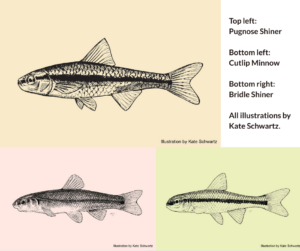
Illustrations of the Pugnose Shiner, Cutlip Minnow, and Bridle Shiner, by Kate Schwartz. Source: https://riverinstitute.ca/research-projects/species-at-risk-fish-research-habitat-restoration/
The Pugnose Shiner, Bridle Shiner, and Cutlip Minnow are unfortunately being threatened by sediment loading, nutrient loading, and habitat modifications. Erosion as a result of shoreline modification leads to sediment transport, increasing turbidity that alters nest substrates and oxygen levels, and reducing foraging success and prey availability (Fisheries and Oceans Canada, 2024; Fisheries and Oceans Canada, 2025). Increasing turbidity in minnow habitat reduces their visibility, alters their schooling behaviour, reduces their swimming speed, and impairs their respiratory function (Fisheries and Oceans Canada, 2024; Fisheries and Oceans Canada, 2025). Turbidity also impedes the growth of submerged aquatic plants, a survival dependent habitat requirement for the Pugnose Shiner and Bridle Shiner (Fisheries and Oceans Canada, 2024; Boucher et al., 2011). Siltation occurs from sediment loading which degrades spawning habitat for these minnow species, suffocates eggs, and disrupts egg and larval development. This results in food chain alteration for many other aquatic and terrestrial species (Fisheries and Oceans Canada, 2024; Boucher et al., 2011; Fisheries and Oceans Canada, 2025). Nutrient loading occurs from contaminants being transported via runoff, or through ineffective wastewater treatment and septic systems (Fisheries and Oceans Canada, 2025). Common contaminant culprits include fertilizers, de-icing salts and sand, pesticides, and heavy metals (Fisheries and Oceans Canada, 2024; Fisheries and Oceans Canada, 2025). The consequence is the development of algal blooms and a reduction in oxygen concentrations, altering water temperatures, flows, and substrates (Fisheries and Oceans Canada, 2024).
Minnow habitat in Canada is diminishing due to shoreline development and hardening (e.g., walls, docks) (Fisheries and Oceans Canada, 2024). During shoreland development, riparian vegetation is removed and without proper post-development restoration, adjacent waterbodies will see increased runoff, erosion, water temperature, and sediment and nutrient loading, ultimately affecting substrate preferences and oxygenation (Fisheries and Oceans Canada, 2024; Boucher et al., 2011; Fisheries and Oceans Canada, 2025). Riparian buffers are a simple way you can protect water quality as buffers slow down water, protect against erosion, trap particles, and filter pollutants (Boucher et al., 2011; Fisheries and Oceans Canada, 2025). Through combined efforts of maintaining your septic system, avoiding the use of phosphate-containing fertilizers, and maintaining a 30 meter natural riparian buffer, you can contribute to the protection and recovery of the Pugnose Shiner, Bridle Shiner, and Cutlip Minnow.
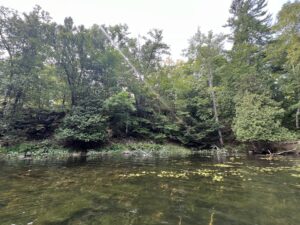
Natural shoreline with a robust riparian buffer and ample aquatic vegetation, ideal habitat for the Pugnose Shiner and Bridle Shiner.
Watersheds Canada, in partnership with the River Institute and Quinte Conservation, over 2025-2027 is delivering a riparian habitat restoration, monitoring, and outreach project aimed at improving the conditions of riparian zones and associated aquatic ecosystems for the Pugnose Shiner, Bridle Shiner, and Cutlip Minnow. This project will implement riparian buffer zones along the shores of East Lake, Moira River, and the St. Lawrence River in benefit of these minnow species, addressing habitat degradation, sedimentation, and nutrient loading threats. Project funded by Fisheries and Oceans Canada.
References
Boucher, J., M. Berubé, A. Boyko and M. Bourgeois. 2011. Management plan for the Bridle Shiner (Notropis bifrenatus) in Canada (Final version). Species at Risk Act Management Plan Series, Fisheries and Oceans Canada, Ottawa. v + 43 pp.
Coad, B. (2015). Minnow. In The Canadian Encyclopedia. Retrieved from https://thecanadianencyclopedia.ca/en/article/minnow
Conservation Commission of Missouri. (2025). Minnows. Missouri Department of Conservation. https://mdc.mo.gov/discover-nature/field-guide/minnows
Fisheries and Oceans Canada. 2025. Management Plan for the Cutlip Minnow (Exoglossum maxillingua) in Canada [Proposed]. Species at Risk Act Management Plan Series. Fisheries and Oceans Canada, Ottawa. iii + 53 pp.
Fisheries and Oceans Canada. 2024. Recovery Strategy for the Pugnose Shiner (Notropis anogenus) in Canada. Species at Risk Act Recovery Strategy Series. Fisheries and Oceans Canada, Ottawa. v + 85 pp.
Watt, A. and Pitcher, T. (2025), Trait-Based Prediction of Conservation Status of North American Small-Bodied Minnows (Leuciscidae) and Darters (Percidae). Aquatic Conserv: Mar Freshw Ecosyst, 35: e70113. https://doi.org/10.1002/aqc.70113