
by Alexa Button, Climate Change Resiliency Intern
The Channel Darter is a rare small member of the perch family. In 2019, the Lake Erie and Lake Ontario populations were placed on the endangered species at risk list (Fisheries and Oceans Canada, 2024). In Ontario, this species can be found in the following waterbodies: St. Clair River, Lake St. Clair, Lake Erie, Detroit River, Trent, Salmon, and Moira River watersheds as well as the Ottawa River (Fisheries and Oceans Canada, 2024). This species inhabits the benthic zone of large lakes and medium to large rivers as their primary diet is benthic invertebrates (Fisheries and Oceans Canada, 2024; COSEWIC, 2016).
Channel Darter spawn in waters ranging from 17.5 to 23.9°C with moderate currents and nearshore areas with clean, coarse sand and fine gravel (COSEWIC, 2016). However, with climate pressures, water temperatures are increasing, impacting the window available for spawning and forcing the species to move northward. In Moira River for example, Water Rangers data shows an increase of 8.6°C from May 2019 to May 2024; this trend is concerning and unfortunately is continuing (Water Rangers, 2025). This species is of interest as it is the only member of the Cottogaster clade group within Percina that is found in Canada and appears to be easily affected by human disturbances (COSEWIC, 2016).
Shoreline modifications and development has led to a loss of Channel Darter habitat within Ontario (Fisheries and Oceans Canada, 2024; COSEWIC, 2016). Riparian vegetation provides critical services such as erosion control, runoff filtration, and water temperature regulation. It is commonly removed during shoreline development. The consequence of this is an increase in sedimentation, runoff of manure and fertilizers, and water temperature (Fisheries and Oceans Canada, 2024; COSEWIC, 2016). There are ways you can help, such as maintaining a 30-meter natural riparian buffer consisting of native trees, shrubs, grasses, and wildflowers which will help with erosion control and the amount of excess nutrients reaching your waterbody (Bilkovic et al., 2016; Smith et al., 2020). Other recommendations include leaving a 10-15 (or more!) strip of shoreline that is un-mowed, choosing environmentally friendly dock options (pipe/post, cantilever and floating), and designing your pathway to the water in an “S” curve covered with wood chips, mulch, gravel, or pine needles to aid in water absorption.
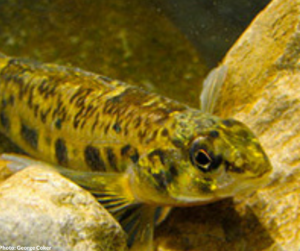
Photo: George Coker. https://www.ontario.ca/page/channel-darter
Excess nutrients from agriculture (manure and fertilizer) and urban (septic) sources are causing nutrient enrichment of Channel Darter waterbodies, leading to algal blooms that reduce the oxygen available for organisms (Fisheries and Oceans Canada, 2024; COSEWIC, 2016; Chislock et al., 2013). Maintaining a natural shoreline, restricting livestock access to waterbodies, keeping up on septic system maintenance, and avoiding the use of phosphate-containing fertilizer/products are all ways you can help to maintain or improve water quality for the Channel Darter (Fisheries and Oceans Canada, 2024; Government of Ontario, 2024). Septic systems are a commonly overlooked source, with system failures often going undetected. Inspecting your septic system frequently, conserving water, properly disposing of waste, and maintaining your drain field are steps you can take that will improve water quality for your benefit and the Channel Darter. To learn more about septic systems and freshwater, check out Watersheds Canada’s free education resource toolkit.
Siltation and turbidity resulting from agricultural and urban (shoreline modifications; docks) sources is reducing the availability of coarse substrates, a feature that is necessary for spawning and egg survival for the Channel Darter (Fisheries and Oceans Canada, 2024; COSEWIC, 2016). These sources are impacting both the availability of benthic invertebrate prey and the capability of the Channel Darter to find prey (Fisheries and Oceans Canada, 2024; COSEWIC, 2016). Maintaining a riparian buffer and planting native vegetation will also aid in erosion control, reducing siltation and turbidity (Fisheries and Oceans Canada, 2024). By planting native vegetation, curving and covering your path in permeable materials, and leaving fallen trees, logs, and branches on your shoreline, you are protecting Channel Darter habitat and your property from erosive loss.
Watersheds Canada, in partnership with the River Institute and Quinte Conservation, is delivering a two-year riparian habitat restoration, monitoring, and outreach project aimed at improving the conditions of riparian zones and associated aquatic ecosystems to benefit species at risk. One main objective of this project is to restore critical habitat along the shores of Moira River, seeking to improve Channel Darter spawning, feeding, and shelter areas for population recovery. Project funded by Fisheries and Oceans Canada.
References
Fisheries and Oceans Canada. 2024. Recovery Strategy and Action Plan for the Channel Darter (Percina copelandi) in Canada (Lake Erie and Lake Ontario populations) [Proposed]. Species at Risk Act Recovery Strategy Series. Fisheries and Oceans Canada, Ottawa. viii + 84 pp.
COSEWIC. 2016. COSEWIC assessment and status report on the Channel Darter Percina copelandi, Lake Erie populations, Lake Ontario populations and St. Lawrence populations, in Canada. Committee on the Status of Endangered Wildlife in Canada. Ottawa. xvi + 68 pp
Bilkovic, D. M., Mitchell, M., Mason, P. A., & Duhring, K. (2016). The role of living shorelines as estuarine habitat conservation strategies. Coastal Management, 44(3), 161–174. https://doi.org/10.1080/08920753.2016.1160201
Smith, C. S., Rudd, M. E., Gittman, R. K., Melvin, E. C., Patterson, V. S., Renzi, J. J., Wellman, E. H., & Silliman, B. R. (2020). Coming to terms with living shorelines: A scoping review of novel restoration strategies for shoreline protection. Frontiers in Marine Science, 7. https://doi.org/10.3389/fmars.2020.00434
Government of Ontario. (2024). Blue-green algae. Retrieved from https://www.ontario.ca/page/blue-green-algae
Chislock, M. F., Doster, E., Zitomer, R. A. & Wilson, A. E. (2013). Eutrophication: Causes, Consequences, and Controls in Aquatic Ecosystems. Nature Education Knowledge. 4(4):10
Water Rangers. (2025). Moira River. Water Rangers Water Quality Testing Data. https://app.waterrangers.ca/locations/2736