
by Jonathan Miller, Freshwater Conservation Intern
Each spring, long before summer wildflowers begin to bloom, two important native pollinators emerge across Canada: the tricoloured bumble bee (Bombus ternarius) and the Canadian tiger swallowtail (Papilio canadensis). These species are more than beautiful signs that warmer weather has arrived; they are essential ecological partners to our forests, gardens, and early-spring plants as they help drive the success of our ecosystems.
By cultivating native spring-blooming plants, creating nesting and overwintering habitat, reducing pesticide use, and spreading awareness, property owners can have a meaningful impact for these spring pollinators.
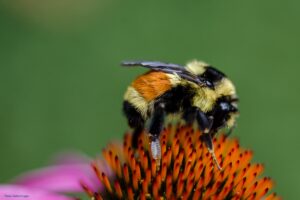
Tricoloured Bumble Bee (Bombus ternarius). Photo: Getty Images.
Starting Early: Why These Pollinators Matter?
The tricoloured bumble bee is among the earliest of the Bombus species to emerge after winter. Queens overwinter underground and appear in late April to establish new colonies (Williams et al., 2014). Early-emerging bumble bees play a unique ecological role, pollinating early-blooming shrubs and wildflowers such as willows, blueberries, serviceberries, and spring ephemerals, which are heavily reliant on more cold-resistant pollinators (Oyen & Dillon, 2018). Because spring temperatures remain unpredictable in much of Canada, species like the tricoloured bumble bee are adapted to forage during cool, variable conditions when other insects would remain inactive.
Meanwhile, the Canadian tiger swallowtail begins its adult flight in late spring, emerging from overwintered pupae as temperatures warm (Ayres & Scriber, 1994). These butterflies serve as key pollinators of lilacs, chokecherries, dogwoods, and a wide array of woodland flowers. Their larvae depend on native trees, particularly poplar, cherry, and willow species, which tie this butterfly’s life cycle to healthy, native forests and riparian habitats (Scriber et al., 2002).
Together, these two species demonstrate how our native pollinators are tightly intertwined with seasonal plant communities. Giving them our support means also supporting entire spring food webs.
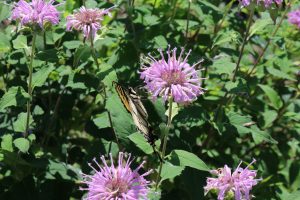
A Canadian Tiger Swallowtail (Papilio canadensis) on a Wild Bergamot wildflower. Photo: Watersheds Canada.
Nesting, Overwintering, and Shelter: Providing A Safe Space For Spring Pollinators
One of the major limiting factors for native pollinators is the availability of habitat for nesting and overwintering. Pollinators’ success in finding suitable nesting and overwintering sites plays a major role in their ability to reproduce and survive as temperatures fluctuate. Tricoloured bumble bees are ground-nesting and often repurpose abandoned rodent burrows, compost piles, grassy knolls, and leaf litter (Colla et al., 2012). The over-cleaning of gardens and shorelines, such as raking away leaf litter or removing downed wood, can unintentionally destroy these essential microhabitats.
Similarly, Canadian tiger swallowtails overwinter as pupae attached to twigs, stems, and leaf litter, where natural debris provides them with insulation and shelter (Ayres & Scriber, 1994). Trying to maintain what is called a “soft landings” approach beneath native shrubs and trees – leaving leaf litter, twigs, and decaying wood intact – will dramatically increase their overwinter survival.
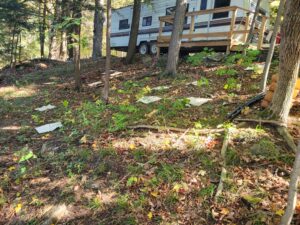
Example of the “soft landings” approach in a shaded area of a property. Photo: Watersheds Canada.
Threats and Conservation
Both the tricoloured bumble bee and the Canadian tiger swallowtail face pressures that threaten their populations. Climate change affects early-season pollinators through phenological mismatch when flowers and pollinators become active at different times (Kudo & Cooper, 2019). It has also resulted in their range being slowly pushed northward. Habitat fragmentation reduces the availability of host plants for butterfly larvae and nesting and overwintering habitats. Insecticides and herbicides negatively affect bee navigation, colony performance, and butterfly larval development (Woodcock et al., 2017; Krupke et al., 2012).
Protecting our intact habitat, especially in key habitats such as riparian and forest-edge environments, is increasingly important for maintaining resilient pollinator populations.
What You Can Do to Help?
Due to the sometimes scarce nature of spring floral resources, planting native wildflowers and shrubs that bloom early can help pollinators tremendously. Early-season floral abundance is strongly linked to wild bee colony success, reproduction, and resilience to outside-stressors (Baldock et al., 2019). Recommended native plants for your property to help the tricoloured bumble bee include willow, blueberry, dogwood, clover, and serviceberry. For the Canadian Tiger Swallowtail, try planting cherry, ash, choke cherry, birch, and aspen.
You can make a measurable difference by adopting different pollinator-friendly practices:
- Plant native shrubs and early blooming wildflowers. Get inspired by others taking action!
- Leave leaf litter and woody debris in garden beds.
- Avoid pesticides, especially systemic insecticides.
- Download resources like a “Wildflower Garden Guide”, “Guide to Preparing a Shoreline Naturalization Planting Plan”, and more in our free E-library.
- Preserve shoreline vegetation whenever possible. Learn about native species to your area using our free Canada-wide Native Plant Database.
- Provide sunny, sheltered foraging areas with diverse flowering plants.
- Symbolically adopting pollinator habitat, and other restoration initiatives led by Watersheds Canada.
Even a small patch of pollinator habitat can work as an important stepping-stone in fragmented landscapes (Baude et al., 2016). By taking simple, habitat-focused actions, we support not only these two pollinator species but entire spring ecosystems that rely on early-season pollinator activity.
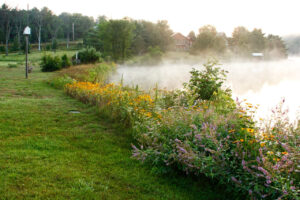
A restored shoreline with hundreds of native wildflower and shrubs. Photo: Watersheds Canada.
References
Ayres, M. P., & Scriber, J. M. (1994). Local adaptation to regional climates in Papilio canadensis (Lepidoptera: Papilionidae). Ecological Monographs, 64(4), 465-482.
Baldock, K. C., Goddard, M. A., Hicks, D. M., Kunin, W. E., Mitschunas, N., Morse, H., … & Memmott, J. (2019). A systems approach reveals urban pollinator hotspots and conservation opportunities. Nature ecology & evolution, 3(3), 363-373.
Baude, M., Kunin, W. E., Boatman, N. D., Conyers, S., Davies, N., Gillespie, M. A., … & Memmott, J. (2016). Historical nectar assessment reveals the fall and rise of floral resources in Britain. Nature, 530(7588), 85-88.
Colla, S. R., & Dumesh, S. (2010). The bumble bees of southern Ontario: Notes on natural history and distribution. Journal of the Entomological Society of Ontario, 141
Environment Canada. (2025, July 21). Pollinator Protection. Government of Canada. https://www.canada.ca/en/health-canada/services/consumer-product-safety/pesticides-pest-management/growers-commercial-users/pollinator-protection.html
Kudo, G., & Cooper, E. J. (2019). When spring ephemerals fail to meet pollinators: mechanism of phenological mismatch and its impact on plant reproduction. Proceedings of the Royal Society B, 286(1904), 20190573.
Krupke, C. H., Hunt, G. J., Eitzer, B. D., Andino, G., & Given, K. (2012). Multiple routes of pesticide exposure for honey bees living near agricultural fields. PLoS one, 7(1), e29268.
Oyen, K. J., & Dillon, M. E. (2018). Critical thermal limits of bumblebees (Bombus impatiens) are marked by stereotypical behaviors and are unchanged by acclimation, age or feeding status. Journal of experimental biology, 221(8), jeb165589.
Schmidt, C., Hockley, L., & Macnaughton, A. (2019). More on Ontario tiger swallowtails. Ontario Lepidoptera, 3-11
Scriber, J. M., Keefover, K., & Nelson, S. (2002). Hot summer temperatures may stop movement of Papilio canadensis butterflies and genetic introgression south of the hybrid zone in the North American Great Lakes region. Ecography, 25(2), 184-192.
Tang, J., Wice, J., Thomas, V. G., & Kevan, P. G. (2007). Assessment of Canadian federal and provincial legislation to conserve native and managed pollinators. International Journal of Biodiversity Science & Management, 3(1), 46–55. https://doi.org/10.1080/17451590709618161
Williams, P., Thorp, R., Richardson, L., & Colla, S. (2024). Bumble bees of North America: an identification guide. Princeton University Press.
Woodcock, B. A., Isaac, N. J., Bullock, J. M., Roy, D. B., Garthwaite, D. G., Crowe, A., & Pywell, R. F. (2016). Impacts of neonicotinoid use on long-term population changes in wild bees in England. Nature communications, 7(1), 12459.
This blog post is part of a series generously funding by the Government of Canada’s EcoAction Community Funding Program, and a project delivered in partnership with Crowe Valley Conservation Authority.