
by Alexa Button, Climate Change Resiliency Intern
In 2019, the status of the Spotted Gar in Canada was uplisted to endangered, signalling the need for change to protect this unique living fossil in our waters (Fisheries and Oceans Canada, 2024). The spotted gar is a freshwater fish with an armoured body, and a long toothy snout, inhabiting quiet pools, backwaters and bays with an abundance of aquatic vegetation or woody debris (Fisheries and Oceans Canada, 2024; Staton et al., 2012).
This species’ known Canadian range is restricted to three coastal wetlands in Lake Erie, however single specimens have been recorded in East Lake, Lake Ontario, as well as unconfirmed historical and potential occurrences in the upper St. Lawrence River (Fisheries and Oceans Canada, 2024; COSEWIC, 2015). The Great Lakes basin is a connected freshwater system, facilitating distribution shifts for native species during the climate shift. The Spotted Gar is likely to expand its range northward with their presence in Lake Ontario increasing in the very near future (Staton et al., 2012; MacGuigan et al., 2023).
The term “living fossil” was first announced by Charles Darwin to describe family species lineages that have not visually evolved for millions of years. Examples of species in this category include the sturgeon and the horseshoe crab, where evolution is either slow or at a standstill (Heidt, 2024). The Gar family in particular is uniquely fascinating, having the slowest rate of molecular evolution of all jawed vertebrates, with ancestors dating back to more than 200 million years ago (Heidt, 2024; Sladek, 2023). To put this rate into perspective, mammals have a rate of 0.02 mutations per million years, while the Gar family has a rate of 0.00009 mutations per million years (Heidt, 2024). Because of this species adaptative ability, and unique evolution rate, two subfamilies of Gars that diverged roughly 20 million years ago are still producing viable and fertile hybrid offspring due to their identical gene sequences (Heidt, 2024; Sladek, 2023; Funnell & Benson, 2024). This unique feature of the Gar family would be the equivalent to if a chimpanzee could produce a fertile offspring with a kangaroo (Funnell & Benson, 2024). While the Spotted Gar possesses these unique and rare characteristics, this living fossil is still at risk.
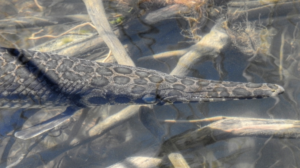
Photo: Spotted Gar on Lake Erie, May 2025. Observation © Ken Bell · all rights reserved.
Various threats are placing the Spotted Gar on the endangered species at risk list. Suitable habitat is disappearing due to shoreline hardening and shoreline structure construction (Fisheries and Oceans Canada, 2024). Shoreline development resulting in shoreline hardening is degrading nearshore habitat for this species (Fisheries and Oceans Canada, 2024). During shoreline development, aquatic vegetation is commonly removed or disturbed, reducing the quality and quantity of vegetated nearshore areas for the spawning, egg, larval, and young of year life stages (Fisheries and Oceans Canada, 2024). Developing within the riparian zone can increase turbidity and sediment and nutrient loading due to improper land use practices. This limits the ability of the Spotted Gar to feed and negatively impacts respiration, vision, prey abundance, and hatchling success (Fisheries and Oceans Canada, 2024).
Climate resiliency action is crucial to minimize associated threats facing the Spotted Gar. Climate change is having global impacts, impacting nearly every living organism, including humans. Aquatic communities are particularly vulnerable to the rising water and air temperatures induced by climate change (Staton et al., 2012). Specifically, the Spotted Gar is the fifth most vulnerable species to climate change out of 99 lake fish species (Fisheries and Oceans Canada, 2024; Staton et al., 2012). Consequently, the surface water temperature of the Great Lakes is rising, specifically Lake Erie where current Spotted Gar populations call home, has increased four degrees from 2000-2025, now sitting at 21.5° (in September) (Great Lakes Coastwatch, 2025). Climate change will continue to feed the rising water temperatures. To mitigate the effects on the Spotted Gar, action must be taken before it is too late.
Watersheds Canada, in partnership with the River Institute and Quinte Conservation, is delivering a two-year riparian habitat restoration, monitoring, and outreach project. Project activities will improve the conditions of riparian zones and associated aquatic ecosystems to restore critical habitat along the shores of East Lake (Prince Edwards County, Ontario) and the upper St. Lawrence River, benefitting the Spotted Gar. Riparian habitat restoration will be addressed using The Natural Edge shoreline naturalization program which focuses on using native plants to stabilize soils, reduce nutrient loading and sedimentation, and improve the climate resiliency of these systems to positively impact this endangered species. Restoration sites will be actively monitored by the River Institute, contributing to filling knowledge gaps in Spotted Gar populations, and gaining information of this species in new areas not previously surveyed. Project funded by Fisheries and Oceans Canada.
References
COSEWIC. 2015. COSEWIC assessment and status report on the Spotted Gar Lepisosteus oculatus in Canada. Committee on the Status of Endangered Wildlife in Canada. Ottawa. xii + 40 pp.
Daniel J. MacGuigan, Isabel Porto-Hannes, Brian M. Foote, Nathan J.C. Backenstose, Christopher A. Osborne, Kimberly Louisor, Hannah M. Waterman, Sarah L. Chang, Jacob L. Cochran, Trevor J. Krabbenhoft, Spotty distributions: Spotted Gar (Lepisosteus oculatus) and Spotted Sucker (Minytrema melanops) range expansion in eastern Lake Erie, Journal of Great Lakes Research, Volume 49, Issue 4, 2023, Pages 931-940, ISSN 0380-1330, https://doi.org/10.1016/j.jglr.2023.05.009.
Fisheries and Oceans Canada. 2024. Recovery Strategy and Action Plan for the Spotted Gar (Lepisosteus oculatus) in Canada. Species at Risk Act Recovery Strategy Series. Fisheries and Oceans Canada, Ottawa. iv + 76 pp.
Funnell, R. (2024, March 7). What is a living fossil? First evidence of a biological mechanism reveals all. IFLScience. https://www.iflscience.com/what-is-a-living-fossil-first-evidence-of-a-biological-mechanism-reveals-all-73272
Great Lakes Coastwatch. (2025, December 29). Lake Erie Average GLSEA Surface Water Temperature (1995 – 2025). NOAA CoastWatch Great Lakes Regional Node. https://apps.glerl.noaa.gov/coastwatch/webdata/statistic/pdf/all_year_glsea_avg_e.pdf
Heidt, A. (2024, March 4). These gars are the ultimate “living fossils.” Science. https://www.science.org/content/article/these-gars-are-ultimate-living-fossils
Sladek, F. (2023, August 1). Gar: Fascinating fossil fish. Outdoor Illinois Journal. https://outdoor.wildlifeillinois.org/articles/gar-fascinating-fossil-fish
Staton, S.K., A.L. Boyko, S.E. Dunn, and M. Burridge. 2012. Recovery strategy for the Spotted Gar (Lepisosteus oculatus) in Canada. Species at Risk Act Recovery Strategy Series. Fisheries and Oceans Canada, Ottawa. vii + 57 p.