
by Jonathan Miller, Freshwater Conservation Intern
In our wetlands, rivers, forests, and shorelines live a quiet, often overlooked group of species: Canada’s native herpetofauna! This is the collective term for amphibians and reptiles encompassing frogs, toads, snakes, turtles, and salamanders. Though small and frequently hidden away, these species play disproportionately important ecological roles in our natural environments. Their presence and absence serve as sensitive indicators of freshwater health, habitat quality, and climate change impacts (Hocking & Babbitt, 2014). They are an integral part of many aquatic and terrestrial food webs, demonstrating their vast influence on the ecology of our ecosystems.
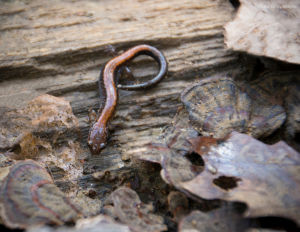
Eastern Red-Backed Salamander (Plethodon cinereus). (Photo: Getty Images Signature)
Amphibians
Amphibians such as frogs, toads, and salamanders are among the earliest wildlife to signal that spring has arrived. Species such as Spring Peeper (Pseudacris crucifer), Wood Frog (Lithobates sylvaticus), and American Toad (Anaxyrus americanus) begin calling in April, often while ice still clings to the edges of ponds. Amphibians rely on clean, fish-free ephemeral wetlands such as vernal pools and vegetated shallows for breeding. The very habitats they need are increasingly threatened by shoreline development (Guderyahn et al., 2016). These species act as both predators of insects and prey for birds, mammals, and reptiles, filling the ecological role that fish play in freshwater ecosystems in their absence.
Amphibians are considered “sentinel species” due to their permeable skin which readily absorbs pollutants. This makes them highly sensitive to hormone-disrupting chemicals, salt pollution (e.g., road salts), and nutrient runoff (Collins, 2010). Population declines often appear in amphibians before other wildlife, thereby providing an early warning to freshwater ecosystem change, and earning these species the title of “bioindicators” alongside other species like macroinvertebrates.
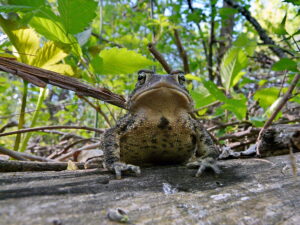
An American Toad (Anaxyrus americanus). (Photo: Simon Lunn)
Snakes
Snakes have intrigued humans for centuries, with many cultures incorporating them into their mythos and lore. Canada is home to more than 25 species of these snakes, including Garter Snake (Thamnophis sirtalis), Northern Watersnake (Nerodia sipedon), and the threatened Eastern Hog-nosed Snake (Heterodon platirhinos). Snakes play a critical role in maintaining ecological balance by controlling rodent populations and serving as both predators and prey in complex food webs (Weatherhead & Madsen, 2009).
Most Canadian snakes rely on hibernacula, which are underground cavities, bedrock fissures, or mammal burrows that they return to year after year. Even a small disturbance to these overwintering sites can eliminate entire local populations. Road mortality is one of the greatest threats to snakes in southern Canada. In some regions, up to 50% of annual adult mortality occurs on roads, especially for species that must migrate between wetlands and hibernation sites (Paterson et al., 2019). Shoreline development and the removal of coarse woody debris also reduce habitat used for nesting and thermoregulation.
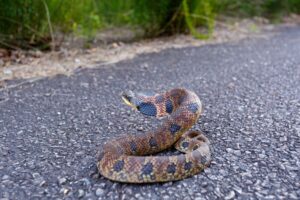
This Eastern Hog-nosed Snake (Heterodon Platirhinos) is a snake species endemic to Ontario. (Photo: Getty Images)
Turtles
Canada’s turtles – including its 8 freshwater species and 4 marine – are ecological keystones. Their foraging behaviours help to maintain wetland nutrient cycling, remove carrion, and enhance seed dispersal (Lovich et al., 2018). Southern Ontario is home to the greatest concentration of Canada’s turtles. Its landscape is dotted with an exceptional diversity of wetlands – including lakes, marshes, rivers, bogs, fens, and ponds – that together create a vast wetland mosaic supporting the highest turtle diversity in the country. These interconnected wetlands provide critical habitat for our native turtles, who need “soft”, undeveloped, shorelines to nest and survive.
Turtles are among the most at-risk vertebrates in the country, with all eight native species now listed as species at risk due to road mortality, nest predation, habitat loss, and illegal collection (COSEWIC, 2023). Their life history makes recovery extremely slow. Turtles depend on decades of adult survival to compensate for high hatchling mortality. This means that the loss of even a few breeding females can cause long-term population declines (Congdon et al., 1993). Shoreline development and vegetation removal, especially on natural beaches, eliminate nesting areas or even expose nests to predators, reducing hatching rates. Protecting our native turtles requires preserving our wetlands and maintaining natural shoreline vegetation, actions that also benefit fish, birds, amphibians, and water quality.
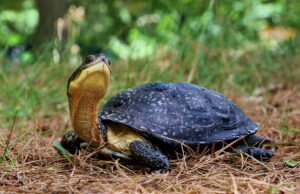
Blanding’s Turtle (Emydoidea blandingii). (Photo: Simon Lunn)
Threats, and What Can be Done to Help?
There are six leading causes of biodiversity loss affecting Canada’s amphibians and reptiles, and each of them individually or in combination contributes to the declines observed in many amphibian and reptile species today. These pressures include: commercial exploitation; the introduction of non-native species that compete with, prey upon, or transmit parasites; habitat loss and alteration; exposure to chemical contaminants; climate change; and infectious diseases (Collins, 2010).
Property owners and community members are capable of making meaningful contributions to help conserve Canada’s amphibians and reptiles, including:
- Preserve and restore natural shoreline vegetation. Consider participating in shoreline restoration programs like The Natural Edge to get started.
- Maintain vernal pools and shallow wetlands.
- Leave logs, leaf litter, and woody brush in place where safe to do so. Access free stewardship guides in Watersheds Canada’s free E-library.
- Use wildlife-friendly mowing schedules (late summer or fall).
- Install turtle-nest protectors where appropriate.
- Avoid using pesticides and herbicides, especially around water.
- Reduce road mortality by supporting wildlife roads and spring signage.
- Supporting environmental charities like Watersheds Canada that are actively restoring wildlife habitat. Make a symbolic adoption of a Blanding’s Turtle, Eastern Red-Backed Salamander, and more through our symbolic adoption program.
Cumulative environmental actions and habitat improvements such as these can have a cascading positive impact not just on our native herpetofauna, but on all wildlife too!
Sources:
Collins, J. P. (2010). Amphibian decline and extinction: what we know and what we need to learn. Diseases of aquatic organisms, 92(2-3), 93-99.
Congdon, J. D., Dunham, A. E., & van Loben Sels, R. C. (1993). Delayed sexual maturity and demographics of Blanding’s turtles (Emydoidea blandingii): implications for conservation and management of long‐lived organisms. Conservation Biology, 7(4), 826-833.
COSEWIC. (2023). Canadian Wildlife Species at Risk. Committee on the Status of Endangered Wildlife in Canada.
Desroches, J. F., Schueler, F. W., Picard, I., & Gagnon, L. P. (2010). A herpetological survey of the James Bay area of Quebec and Ontario. The Canadian Field-Naturalist, 124(4), 299-315.
Dudgeon, D., Arthington, A. H., Gessner, M. O., Kawabata, Z. I., Knowler, D. J., Lévêque, C., … & Sullivan, C. A. (2006). Freshwater biodiversity: importance, threats, status and conservation challenges. Biological reviews, 81(2), 163-182.
Guderyahn, L. B., Smithers, A. P., & Mims, M. C. (2016). Assessing habitat requirements of pond-breeding amphibians in a highly urbanized landscape: implications for management. Urban Ecosystems, 19(4), 1801-1821.
Hocking, D. J., & Babbitt, K. J. (2014). Amphibian contributions to ecosystem services. Herpetological conservation and biology.
Kaylor, S. D. (2006). The breeding ecology and natural history of Ambystomatid salamanders in an ephemeral wetland in Mason County, West Virginia. Marshall University.
Lovich, J. E., Ennen, J. R., Agha, M., & Gibbons, J. W. (2018). Where have all the turtles gone, and why does it matter?. BioScience, 68(10), 771-781.
Paterson, J. E., Pulfer, T., Horrigan, E., Sukumar, S., Vezina, B. I., Zimmerling, R., & Davy, C. M. (2021). Individual and synergistic effects of habitat loss and roads on reptile occupancy. Global Ecology and Conservation, 31, e01865.
Stocking, W. F. (2000). Evaluating effects of fish stocking on amphibian populations in wilderness lakes. In Wilderness Science in a Time of Change Conference: Wilderness ecosystems, threats, and management (Vol. 5, p. 328). US Department of Agriculture, Forest Service, Rocky Mountain Research Station.
Weatherhead, P. J., & Madsen, T. H. O. M. A. S. (2009). Linking behavioral ecology to conservation objectives. Snakes: ecology and conservation, 149-171.