
by Holly Douglas, Environmental Technician Placement Student
Whether they’re darting through wildflowers along a lakeshore, gathering pollen in a backyard, or nesting quietly beneath bare patches of soil, native bees are hard at work across Canada every spring. And while they may be small, their role in keeping our ecosystems healthy is anything but.
This World Bee Day (May 20th) is an opportunity to celebrate these incredible pollinators and reflect on how the choices we make on our own properties can help protect them.
When people think of bees, honeybees are the main species that come to mind, but Canada is home to more than 850 species of native bees, many of whom have evolved alongside the plants and landscapes we know so well (Packer et al., 2007). These species pollinate native wildflowers, shrubs, and trees, helping maintain the biodiversity that supports healthy shorelines, wetlands, forests, and freshwater systems.
Unfortunately, our native bee populations are facing immense pressures. Habitat loss, pesticide exposure, climate change, and landscape fragmentation are making it harder for many species to find the food and nesting places vital to their survival (Potts et al., 2010; Goulson et al., 2015). For example, researchers in Ontario have found that wild bee populations need significantly more natural habitat than many landscapes currently provide in order for them to remain healthy and diverse (Pindar et al., 2023).
The good news is even small changes at home can make a significant difference.
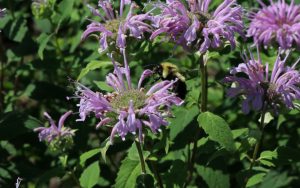
Native Bees You Might Spot This Spring
If you live near a lake, river, wetland, or naturalized yard, there’s a good chance you’re already sharing your space with native pollinators.
The Common Eastern Bumble Bee (Bombus impatiens) is one of Canada’s most familiar native bee species. These fuzzy pollinators are especially important because they can “buzz pollinate”, vibrating flowers to release pollen from plants like blueberries and tomatoes (De Luca & Vallejo-Marín, 2013). You might also notice Leafcutter Bees (Megachile species), which cut small circular pieces out of leaves to build and line their nests. Despite their small size, they are highly effective pollinators and an important part of many local ecosystems (Sheffield et al., 2011).
Then there are Mining Bees (Andrena species), some of the earliest bees to emerge in spring. These bees nest underground, often in sunny patches of exposed soil, and play an important role in pollinating early-blooming trees and shrubs (Gibbs et al., 2017). Unlike honeybees, most native bees are solitary and non-aggressive. Many people never notice them at all.
How to Support Native Bees on Your Property
Helping pollinators doesn’t mean transforming your property overnight. Often the most effective changes are also the simplest.
Plant Native Species
One of the best things you can do is choose native plants that bloom throughout the growing season. Native plants provide the pollen and nectar that local bee species have evolved to rely on, and studies show they support greater pollinator diversity than many ornamental non-native species (Morandin & Kremen, 2013).
Here at Watersheds Canada, we encourage property owners to explore native planting and shoreline stewardship resources through our free E-library, where practical guidance can help create natural spaces that support pollinators while strengthening shoreline health and protecting water quality.
Naturalize Your Shoreline
Traditional lawns and hardened shoreline edges may look tidy, but they offer very little habitat for pollinators.
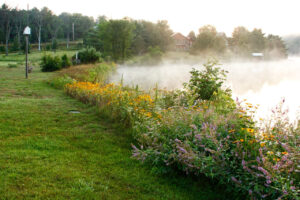
Through The Natural Edge, Watersheds Canada works with shoreline property owners, waterfront groups, and municipalities to restore natural buffers using native trees, shrubs, grasses, and wildflowers. These naturalized spaces provide food and shelter for bees while also reducing erosion, filtering runoff, and helping protect freshwater ecosystems.
Research shows that restored natural habitat adjacent to developed areas can significantly increase the abundance and diversity of wild bee populations (Kremen & M’Gonigle, 2015). Healthy shorelines and healthy pollinator habitat often go hand in hand.
Leave Some Spaces Wild
Around 70% of native bee species nest in the ground (Michener, 2007), while others rely on hollow stems, leaf litter, and dead wood. Leaving a small patch of bare soil, delaying garden cleanup in spring, or allowing some stems to remain standing over winter can provide critical nesting habitat. While bee hotels are popular, they require regular maintenance to prevent disease and parasite build-up (Maclvor & Packer, 2015). In many cases, natural nesting spaces are the better option.
Reduce Pesticide Use
Even low levels of pesticide exposure can affect a bee’s ability to forage, navigate, and reproduce (Woodcock et al., 2017). Whenever possible, choose natural alternatives and focus on creating resilient, diverse landscapes that support ecological balance.
Celebrate World Bee Day Through Action
This World Bee Day, consider taking one small step for pollinators:
- Plant native wildflowers and restore part of your shoreline.
- Explore Watersheds Canada’s resources.
- Support habitat restoration through a Symbolic Adoption with Watersheds Canada. Symbolic Adoptions help fund conservation efforts that create healthier landscapes for native bees and countless other species.
When we create space for pollinators, we’re doing more than helping bees: we’re strengthening the natural systems that keep our watersheds and communities thriving. This World Bee day, let’s create landscapes that truly buzz with life.
References
De Luca, P. A., & Vallejo-Marín, M. (2013). What’s the “buzz” about? The ecology and evolutionary significance of buzz-pollination. Current Opinion in Plant Biology, 16(4), 429–435. https://doi.org/10.1016/j.pbi.2013.05.002
Gibbs, J., Packer, L., Dumesh, S., & Danforth, B. N. (2017). Revision and reclassification of Canadian Andrena species. Zootaxa, 4271(1), 1–89.
https://doi.org/10.11646/zootaxa.4271.1.
Goulson, D., Nicholls, E., Botías, C., & Rotheray, E. L. (2015). Bee declines driven by combined stress from parasites, pesticides, and lack of flowers. Science, 347(6229).
https://doi.org/10.1126/science.1255957
Kremen, C., & M’Gonigle, L. K. (2015). Small-scale restoration in intensive agricultural landscapes supports pollination services. Ecology Letters, 18(8), 719–726.
https://doi.org/10.1111/ele.12424
MacIvor, J. S., & Packer, L. (2015). “Bee hotels” as tools for native pollinator conservation. PLOS ONE, 10(3). https://journals.plos.org/plosone/article?id=10.1371/journal.pone.0122126
Michener, C. D. (2007). The Bees of the World (2nd ed.). Johns Hopkins University Press.
https://jhupbooks.press.jhu.edu/title/bees-world
Morandin, L. A., & Kremen, C. (2013). Hedgerow restoration promotes pollinator populations and exports native bees into adjacent fields. Ecological Applications, 23(4), 829–839. https://doi.org/10.1890/12-1051.1
Packer, L., Genaro, J. A., & Sheffield, C. S. (2007). The bee genera of eastern Canada. Canadian Journal of Arthropod Identification. https://cjai.biologicalsurvey.ca/articles.php?id=92
Pindar, A., et al. (2023). Habitat thresholds for wild bee biodiversity in southern Ontario landscapes. Scientific Reports. https://www.nature.com/articles/s41598-022-26872-x
Potts, S. G., et al. (2010). Global pollinator declines: Trends, impacts and drivers. Trends in Ecology & Evolution, 25(6), 345–353. https://doi.org/10.1016/j.tree.2010.01.007
Sheffield, C. S., et al. (2011). Pollination ecology in eastern Canada. https://cdnsciencepub.com/
Woodcock, B. A., et al. (2017). Country-specific effects of neonicotinoid pesticides on honey bees and wild bees. Science, 356(6345), 1393–1395. https://doi.org/10.1126/science.aaa1190