
by Ty Fischer, Freshwater Health Coordinator
Whether you are a cottage owner, canoe tripper, or a freshwater researcher, it is easy to foster deep personal ties to the freshwater systems in our lives. However, we do not often enough think about the legacy of the water these systems hold. These ancient processes connect freshwater areas like lakes, rivers, wetlands, creeks, and ponds to us.
The interconnectedness of our freshwater is a large part of what makes it so valuable in the first place. Because watersheds connect terrestrial, freshwater, and coastal ecosystems, they are responsible for maintaining a variety of services, including the supply and purification of freshwater (Postel, Thomas, 2009). The high level of connection between systems allows them to be in a state of flux, constantly bringing in the new and flushing out the old.
So too does this connectivity mandate a level of responsibility as we all use and enjoy these resources. The actions of those upstream influence those downstream. By their very nature, watersheds distribute the effects of the various human activities experienced along them throughout their length (Shepardson et al., 2007). This means that the choices we make every single day have direct impacts on others downstream from us – we all share a responsibility to limit our use and impacts.
In order to understand how we can do this, we first need to understand what a watershed is. A ‘watershed’ is a term that encompasses all this connectivity, and puts it into a management perspective. In simplest terms, a watershed is defined as an area of land that drains to a point on a river (Meierdiercks et al., 2024). Every watershed begins its journey as precipitation or snow or glacial melt (NOAA, n.d.). Passing over changes in topography on the earth’s surface (Shepardson et al., 2007), the sources combine: the drips become trickles, the trickles become streams, and the streams become rivers. Some of the water also infiltrates into the ground to recharge groundwater sources.
Watersheds can vary in size depending on the scope used. In Canada, there are only 5 major watersheds (also called ocean watersheds) that are entirely distinct from each other, but each can be further subdivided into different hierarchies of sub-watersheds (Government of Canada, n.d.). Therefore, we can say that watersheds are nested in organization; that many smaller ones make up few larger ones (Aldridge, Baker, 2017).
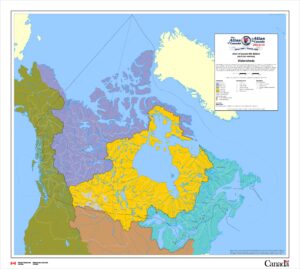
Photo source: Natural Resources Canada. (2025). “Land and Water”. Government of Canada. Internet: https://natural-resources.canada.ca/maps-tools-publications/maps/atlas-canada/land-water
Why do we organize them in such a way? Denoting the boundaries of watersheds as such is important for water governance, as it allows us to integrate the social, political, and environmental systems the water traverses (Davidson, de Loe, 2014). In other words, it allows for more specific, targeted management of our freshwater systems based on the needs of the water system itself and the needs of the local human populations. It allows for specialized approaches and local knowledges to influence freshwater management.
You may be asking yourself at this point: well, what watershed am I found in? There are a number of different online resources that can be used to help you figure it out. If you are located in Ontario, the Ontario Watershed Boundaries (OWB) map is one of the best: simply zoom to see as the different levels of watersheds reveal themselves as you hone in on your hometown! If you are located in another province or territory, you can find similar interactive resources for each one – or see all of Canada’s watersheds and sub-watersheds here.
A healthy watershed is one that sustains ecosystem function and provides all that is necessary for human well-being (Aldridge, Baker, 2017). This is often a tough balance to strike; however, understanding what a watershed is, and what our watershed is, allows us to identify the portion that we are affecting in our lives and be able to take action to protect it for the good of all those downstream.
Sources
Aldridge, C. A., & Baker, B. H. (2017). Watersheds: Role, Importance, & Stewardship. https://doi.org/Publication 3082 (POD-05-17)
Davidson, S. L., & de Loe, R. C. (2024). Watershed Governance: Transcending Boundaries. Water Alternatives, 7(2), 367–387.
Discover Canada’s watersheds. Government of Canada. (n.d.). https://open.canada.ca/data/en/dataset/96c80880-9229-59ec-b508-63b5c10cc35a
Government of Canada / Gouvernement du Canada. (2010, November 18). Water sources: estuaries. Canada.ca. https://www.canada.ca/en/environment-climate-change/services/water-overview/sources/estuaries.html
Meierdiercks, K. L., Finewood, M. H., & Bennett, C. (2024). Defining the term watershed to reflect modern uses and functions as inter- and intra-connected socio-hydrologic systems. Journal of Environmental Studies and Sciences, 14(2), 236–255. https://doi.org/10.1007/s13412-024-00891-8
Postel, S. L., & Thompson, B. H. (2005b). Watershed Protection: Capturing the benefits of Nature’s water supply services. Natural Resources Forum, 29(2), 98–108. https://doi.org/10.1111/j.1477-8947.2005.00119.x
Shepardson, D. P., Wee, B., Priddy, M., Schellenberger, L., & Harbor, J. (2007a). What is a watershed? implications of student conceptions for environmental science education and the National Science Education Standards. Science Education, 91(4), 554–578. https://doi.org/10.1002/sce.20206
What is a watershed?. NOAA’s National Ocean Service. (n.d.-a). https://oceanservice.noaa.gov/facts/watershed.html