
by Ty Fischer, Freshwater Health Coordinator
Whether you are on a boat in a large lake, hiking next to a thunderous waterfall, or navigating the rapids on a river, the sheer power of water can be truly striking at times. That power can lead to destructive event of flooding and high water. These massive overflows of water can sweep away entire communities, leaving a trail of damage to infrastructure and property that can take years to build up again. In fact, floods have been found to affect the most people of any natural disaster worldwide (Erickson et al., 2019), having impacts that reach far and wide and last throughout years or even decades.
Floods can have impacts that are not immediately visible in the way of water quality. In populated regions with significant industrial development, floodwaters can sweep up chemical spills, heavy metals, invasive species, sewage, and debris and shuttle them all downstream. These compounds can lead to increased incidence of disease, infection, and malnutrition, in addition to a suite of environmental hazards that affect entire freshwater ecosystems and all the species they support.
With these risks to us and to wildlife, and with the threat of climate change adding an extra layer of unpredictability about flooding event frequency and intensity, public knowledge about flooding events is important now more than ever. After all, understanding a threat is the first step towards preventing harm from it. It is of particular importance to understand the level of risk for your community, family, and property, and one of the most crucial ways to do so is by knowing more about floodplains.
A floodplain is defined as a low-lying section of land found next to a river that experiences periodic flooding from it (Opperman et al., 2013). Approximately 15 million square-kilometers of the world’s land surface is covered by floodplains, and an estimated 2 billion people live in these areas globally (Devitt et al. 2023). The reason floodplains are so frequently developed is that they provide significant value to us as humans, being used globally for fishing, agriculture, pasture, timber, and more (Opperman et al., 2013).
To protect life and infrastructure in these areas, various flood control measures are employed, including dikes, levees, and seawalls. However, these structures have a designed capacity that, when exceeded by a particularly strong flood event, can cause even more disastrous damage than would happen without them (Li et al., 2016). Therefore, people living in such ‘protected’ floodplains are prone to low-frequency, but high-risk, flooding events, and they are often, unfortunately, unequipped to deal with such events when they happen (Devitt et al., 2023).
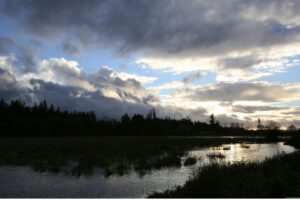
A floodplain, located in the Fraser Valley, British Columbia. (Photo: Getty Images Signature)
How can we know if you are living on a floodplain, and your associated level of flood risk? Many watershed groups and conservation authorities that oversee specific watersheds will provide thorough maps of the area, which often include borders of the floodplains. A great resource that compiles all flood mapping resources currently available in Canada is FloodSmart Canada. Here, you can find your province or territory, your watershed, and the proximity of your home to floodplains. If you need further help, you can always check in with your local government, your insurance provider, or your realtor – one or all should know if your home is on a floodplain and be able to provide details about it (Watershed Watch, 2025).
If you do live on a floodplain, there are steps you can take to protect your home. When it comes to flooding, small changes in the right places can make all the difference. You can prevent water from entering through your windows by putting weather protection sealant around the seams and adding floodshields around basement windows and doors. To help protect your basement and its contents, you can check your sump pump (and have a backup battery for it ready), install a water alarm, and unblock basement drains (Government of Canada, 2022). Outside your home, be sure to clean out all gutters so they drain effectively, and ensure that the downspouts extend at least 2m from the basement wall. Lastly, you can ensure that your property is properly graded; the ground should be such that water drains away from the basement walls (Government of Canada, 2022). More information about preparing your home to deal with flooding events can be found at this Government of Canada website.
There are other changes besides those in and around your home that can protect your family and your wealth from flooding damage. One very important one is to call your insurance provider in order to find out about your flood coverage, and to seek a new provider if your current flood coverage is inadequate. You can also prepare an emergency evacuation plan and an emergency supply kit, in case you are left without power after a flood. Lastly, it is vitally important to stay informed with region-specific flood information; you can find such flood resources here.
Changes to our land use can also reduce overall flood risk on a regional scale. Many natural features offer flood protection, buffering against excessive water flowing over the land. Watersheds Canada’s nationally-delivered shoreline naturalization program, The Natural Edge, builds up native plant communities near shorelines which are proven to slow the flow of surface water runoff and lessen the volumes of floods (Bilkovic et al., 2016), among many other benefits. In addition, protecting and restoring wetlands is very important; in addition to climate change mitigation, wetlands play the crucial role of soaking up excess water like a sponge before it has the chance to build up and contribute to floods (Government of Canada, 2021).
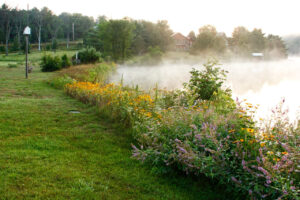
A vegetated buffer of native trees, shrubs, and wildflowers can help protect low-lying shorelines from flooding events.
By reading this blog post, you have taken the first step towards protecting your home and your family from this threat. The work does not end here: taking consistent and active measures to stay informed, protected, and vigilant about flood risk is the key to ensuring long-term safety of your family and your home from this powerful natural phenomenon.
Sources
Azeez, L. (2025, August 7). Do you live in a floodplain? why it matters and how to find out. Watershed Watch Salmon Society. https://watershedwatch.ca/stories/do-you-live-in-a-floodplain/
Bilkovic, D. M., Mitchell, M., Mason, P. A., & Duhring, K. (2016). The role of living shorelines as estuarine habitat conservation strategies. Coastal Management, 44(3), 161–174. https://doi.org/10.1080/08920753.2016.1160201
Devitt, L., Neal, J., Coxon, G., Savage, J., & Wagener, T. (2023). Flood hazard potential reveals global floodplain settlement patterns. Nature Communications, 14(1). https://doi.org/10.1038/s41467-023-38297-9
Erickson, T. B., Brooks, J., Nilles, E. J., Pham, P. N., & Vinck, P. (2019). Environmental health effects attributed to toxic and infectious agents following hurricanes, cyclones, flash floods and major hydrometeorological events. Journal of Toxicology and Environmental Health, Part B, 22(5–6), 157–171. https://doi.org/10.1080/10937404.2019.1654422
Government of Canada (2022, March 7). Government of Canada. Canada.ca. https://www.canada.ca/en/campaign/flood-ready/prepare-home.html
Government of Canada (2021, February 2). Government of Canada. Canada.ca. https://www.canada.ca/en/environment-climate-change/services/water-overview/sources/wetlands.html
Li, C., Cheng, X., Li, N., Du, X., Yu, Q., & Kan, G. (2016). A framework for flood risk analysis and benefit assessment of flood control measures in urban areas. International Journal of Environmental Research and Public Health, 13(8), 787. https://doi.org/10.3390/ijerph13080787
Opperman, J. J., Galloway, G. E., & Duvail, S. (2013). The multiple benefits of river–floodplain connectivity for people and Biodiversity. Encyclopedia of Biodiversity, 144–160. https://doi.org/10.1016/b978-0-12-384719-5.00325-7