
by Ty Fischer, Freshwater Health Coordinator
Millions of years ago, great frozen giants covered our land. The rapid temperature increase following the ice ages caused the mile-thick glaciers to recede, gouging the earth and pushing sediment to form sharp moraines (NOAA, n.d.). Then, the water from their melt filled the great depressions, leaving behind what we now call lakes (NSIDC, n.d.).
This process is responsible for much of the landscape we have in Canada. With more lakes than any country in the world (Deutsch et al., 2022), the scale of these ancient vestiges of the ice age is truly staggering to behold. Combined with our over 8,500 rivers (Canadian Geographic, 2025) and 1.25 million square-kilometres of wetlands (Government of Canada, 2025a), it is no overstatement to say that freshwater is one of Canada’s most abundant and precious resources.
These freshwater systems are not only defining our landscape; their influence is deeply intertwined with so much of our modern lives. For instance, agriculture, electric power generation, municipal waterworks, and wastewater treatment all rely on clean, abundant freshwater. Our industries, and by extension our economies, need it for the manufacturing of chemical, petroleum, metal, and paper products, among many other things (Muller, 1985). Beyond those, we drink these waters, and swim, canoe, and fish in them. They are the lifelines of our country, as our veins are the lifelines in us.
Our freshwater systems sustain an astounding diversity of native wildlife, too. Approximately 19.1% of all macroscopic species found in Canada, including amphibians, reptiles, fish, macroinvertebrates, birds, and mammals, rely directly on freshwater to complete important parts of their life cycle. This uniquely high ecological value means that proper management of these resources can have strong impacts on global ecosystem services and functions, in addition to overall conservation goals (Desforges et al., 2022).
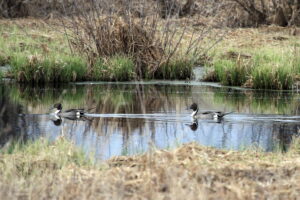
Two Northern Pintail drakes use a wetland as a stopover area for the day (Photo: Simon Lunn).
While commonly cited as holding 20% of the world’s freshwater resources between our borders, in truth, only about 7% of this amount is renewable (Government of Canada, 2025b). Renewable freshwater circulates in the system and is constantly replenished by precipitation and water in-flows, while non-renewable freshwater is stored in glaciers, large lakes, aquifers, and ice caps and has a low rate of recharge (Statistics Canada, 2017). Canada still has the third largest amount of renewable freshwater in the world, though, so it is therefore of supreme importance to protect these expansive and dynamic resources.
The first step in protecting our freshwater and everything connected to it is information gathering. This can take place through water quality sampling, community science programs, performing species at risk and invasive species surveys, biomonitoring, and more. We can then make informed decisions on which targeted actions to take to most directly and most efficiently protect and build resilience for freshwater systems. This can happen through such endeavours as fish habitat restoration projects, large-scale infrastructural projects, pollution management, municipal policies, and invasive species removal, to name a few.
The responsibility of performing this work is mostly divided between conservation groups (e.g., conservation authorities, watershed groups), Indigenous communities, government agencies, and non-profit organizations, each with their own advantages and expertise. Collaboration between all is necessary for freshwater protection, but it does not end there – we need to start broadening our lens on freshwater conservation, so that it encapsulates not only municipalities but entire watersheds. After all, everything is connected!
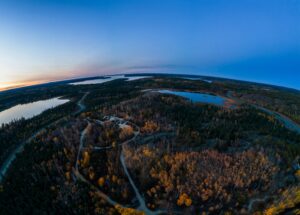
The water upstream influences what is downstream. An aerial photo of the North Slave region in the Northwest Territories helps illustrate this concept. (Photo: Luke Moore)
Each of us holds the well-being of our precious lakes and rivers in our hands. You can protect freshwater yourself by volunteering for local conservation projects, getting involved with local council decisions, donating to freshwater organizations like Watersheds Canada, reducing your use of environmentally harmful products, restoring your waterfront property’s shoreline with native plants, and having conversations about this topic with family and friends.
Much like the glaciers that roamed our land, we can leave behind a legacy that transcends time. Protecting what these giants bestowed upon us will benefit generations to come and allow them to have the same pristine, vibrant freshwater ecosystems that we enjoy ourselves.
Sources
Desforges, J. E., Clarke, J., Harmsen, E. J., Jardine, A. M., Robichaud, J. A., Serré, S., Chakrabarty, P., Bennett, J. R., Hanna, D. E. L., Smol, J. P., Rytwinski, T., Taylor, J. J., Martel, A. L., Winegardner, A. K., Marty, J., Taylor, M. K., O’Connor, C. M., Robinson, S. A., Reid, A. J., & Creed, I. F. (2022). The alarming state of freshwater biodiversity in Canada. Canadian Journal of Fisheries and Aquatic Sciences, 79(2), 352–365. https://doi.org/10.1139/cjfas-2021-0073
Deutsch, E. S., Fortin, M.-J., & Cardille, J. A. (2022). Assessing the current water clarity status of ~100,000 lakes across southern Canada: A remote sensing approach. Science of The Total Environment, 826, 153971. https://doi.org/10.1016/j.scitotenv.2022.153971
Extent of Canada’s Wetlands. Government of Canada. (2025, July 8th, 2025) https://www.canada.ca/en/environment-climate-change/services/environmental-indicators/extent-wetlands.html
Glaciers. Science of Glaciers | National Snow and Ice Data Center. (n.d.). https://nsidc.org/learn/parts-cryosphere/glaciers/science-glaciers
Government of Canada (2025a, July 8). Extent of Canada’s Wetlands. https://www.canada.ca/en/environment-climate-change/services/environmental-indicators/extent-wetlands.html
Government of Canada. (2025b, March 7). Water use in Canada. https://www.canada.ca/en/environment-climate-change/services/environmental-indicators/water-use.html
Canadian Geographic. (2025, April 3) .Interactive map. https://canadaoceanmap.ca/
McKitrick, R., Aliakbari, E., Stedman, A. (2018). Evaluating the State of Fresh Water in Canada. Fraser Institute. http://www.fraserinstitute.org
Muller, R. A. (1985). The value of water in Canada. Canadian Water Resources Journal, 10(4), 12–20. https://doi.org/10.4296/cwrj1004012
National Snow and Ice Data Center. (n.d.). Glaciers. Science of Glaciers. https://nsidc.org/learn/parts-cryosphere/glaciers/science-glaciers
National Oceanic and Atmospheric Administration. (n.d.). Great Lakes ecoregion. https://www.noaa.gov/education/resource-collections/freshwater/great-lakes-ecoregion
Statistics Canada (2017). Human Activity and the Environment 2016: Freshwater in Canada. Catalogue no. 16-201-X. <https://www150.statcan.gc.ca/n1/en/pub/16-201-x/16201-x2017000-eng.pdf?st=qGVGonRF>. Accessed September 22nd, 2025