
by Jonathan Miller, Freshwater Conservation Intern
Flooding is no longer a rare or distant threat for Canadians. From spring snowmelt and ice jams to intense summer rainstorms, communities are experiencing floods more frequently and with greater impacts. Roads wash out, basements fill with water, drinking water sources get compromised, and wetlands that help to buffer floods become degraded. As these events become more common, an important question emerges for residents and decision-makers alike: Is my town truly flood-ready?
Understanding Your Local Flood Risk
Flood risk looks different across communities. Some communities face riverine flooding from swollen rivers and creeks, while others deal with shoreline flooding along large lakes like the Great Lakes. Many urban and suburban areas are vulnerable to surface flooding when stormwater systems are overwhelmed. Rural communities often face a combination of risks, including flooded roads, damaged culverts, and the possibility of isolation when roads are cut off.
A flood-ready town starts with knowledge, including an understanding of local hazards and emergency procedures (Moghal & Peddle, 2016). Residents should be able to easily find tools like local flood hazard maps, flood warning and alert systems, and emergency contacts and evacuation routes. These tools allow residents and decision-makers to make informed choices on emergency response and property protection, which research has shown to be critical in flood preparedness and resilience (Moghal & Peddle, 2016). Without the proper information, we are left to react to emergencies rather than prepare for them.
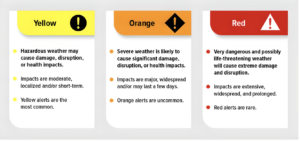
The Federal Government’s new colour-coded weather alert system. Source: https://www.canada.ca/en/services/environment/weather/severeweather/weather-alerts/colour-coded-alerts.html
Steps To Increasing Flood Resiliency
Flood resiliency is built through coordinated actions and proper emergency preparedness. Communities that are better prepared tend to share some of the common features listed below:
- Proper land-use planning
Flood-ready towns will limit new development in flood-prone areas and protect their local floodplains and shorelines.
- Up-To-Date Infrastructure
Aging stormwater systems, undersized culverts, and poorly maintained ditches are among the main culprits that increase flood risk. Regular system maintenance, paired with the implementation of nature based solutions and low-impact development can help communities handle heavier rainfall and reduce the pressure on municipal systems.
- At Home Protections
At your house, adaptive measures such as installing backwater valves, sealing any foundation penetrations, adjusting site grading, and maintaining emergency supplies have been identified as effective risk-reduction strategies (Government of Canada, 2025). Municipal programs that support these actions through rebates or education also make a significant difference.
- Clear Emergency Communication
Clear, precise communication in the event of a flood will help to prevent damage. Flood warnings should be timely and, most importantly, easy to understand. Clear messaging will help people act early, protecting lives and property. Flood resilience is strongest when the responsibility is shared among communities.
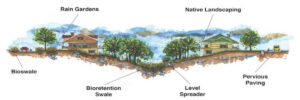
Example of Low Impact Development (LIDs). Source: https://www.nvca.on.ca/low-impact-development/
Moving From Awareness Into Action
Flood readiness isn’t a checklist you complete once and forget, but rather an adaptive process that requires ongoing work and changes in response to evolving climatic conditions. It is an ongoing process that evolves as climate conditions change and communities continue to grow. Towns that succeed are those that invest in prevention as much as their response while embracing nature-based/low-impact solutions to flooding (Moghal & Peddle, 2016). By asking the question of whether your town is flood-ready and pushing for the resources and policies needed to make the answer “yes”, you help protect not only your home, but the health of your watershed.
Flooding may be inevitable, but the damage it causes doesn’t have to be. Check out our Flooding and Water Scarcity page for more information on the issue.
References
Government of Canada. (2025, September 12). Get prepared. https://www.canada.ca/en/services/policing/emergencies/preparedness/get-prepared.html.
Government of Ontario. (2020). Ontario flooding strategy: Protecting people and property. Ministry of Natural Resources and Forestry. https://www.ontario.ca/page/protecting-people-property-ontarios-flooding-strategy.
Moghal, Z., & Peddle, S. (2016). At the front lines of flood: How prepared are Ontario communities. Retrieved from: https://uwaterloo.ca/partners-for-action/sites/ca.partners-oraction/files/uploads/files/p4a_front_lines_of_the_flood_04jul16.pdf.
Nottawasaga Valley Conservation Authority. Low Impact Development (LID). https://www.nvca.on.ca/low-impact-development.
This resource is part of an education toolkit generously funded by: