
by Jonathan Miller, Freshwater Conservation Intern
Canada has been seeing increases in rainfall over the last six decades. Climate forecasts indicate, for example, that Ontario could receive up to 240 millimetres more annual precipitation by the end of this century. As Canadians, we need to be prepared to deal with our changing climate. Climate models show varying trends across the country, such as more frequent heavy rainfall events and prolonged summer droughts over the coming decades. These changes place stress on our local ecosystems and communities across both rural and urban landscapes. Over the next couple of weeks, Watersheds Canada will be delivering resources to raise awareness of flooding and water scarcity.
Already, many regions are experiencing greater seasonal variability in their water availability. Severe rainstorms have overwhelmed aging stormwater systems and shoreline infrastructure, while unusually dry summers are lowering water levels and putting stress on wetlands (Moghal & Peddle, 2016). If these patterns continue, many watersheds will face increasing concerns and competition over limited water supplies. Understanding your watershed’s risk has never been more important.
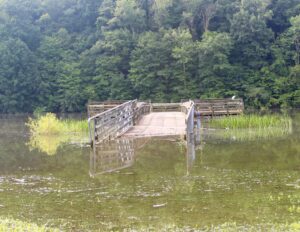
How Flooding Threatens Communities
Flooding is a costly natural hazard and its impacts are becoming more widespread. Increased precipitation intensity and changing freeze-thaw cycles are contributing to higher peak flows during storms (Carter & Steinschneider, 2018). This causes rivers and wetlands to exceed their natural storage capacity, accelerating shoreline erosion while reducing water quality by transporting contaminants, sediments, and nutrients into waterways.
Urban areas are particularly vulnerable, as paved surfaces limit natural infiltration (Moghal & Peddle, 2016). Meanwhile, many of our rural watersheds have lost wetlands that once acted as natural buffers, absorbing stormwater and slowly releasing it downstream.
The Growing Concern over Water Scarcity
Despite being home to one-fifth of the world’s freshwater, Canada is not immune to drought. Low water levels have been recorded more frequently in recent years, with streams, lakes, and rivers experiencing significantly reduced summer flows. Decreased water availability directly affects our aquatic ecosystems, reducing habitat for fish, amphibians, reptiles, and migratory birds. These pressures are amplified by increasing temperatures, which heighten evaporation and reduce the amount of water stored in lakes and soil (Mortsch et al., 2015).
Are You in a Flood-Vulnerable Area?
An area’s flood risk varies widely depending on your watershed characteristics. You may be in a higher-risk area if you live near:
- A river, creek, or floodplain
- A low-lying shoreline or wetland
- A steep watershed with fast-moving runoff
- Urban areas with significant amounts of impervious surfaces (roads, parking lots, subdivisions)
- A region with historic flooding events or flood hazard mapping
Conservation authorities or similar watershed groups maintain floodplain maps and watershed report cards that help to identify local vulnerabilities. Check with your provincial or territorial governments to see if they have a flood forecasting and warning program to prepare local authorities, such as this Government of Ontario example. Communities and landowners need resources to prepare for flooding.
A Call for Action
Watersheds across Canada are undergoing rapid environmental change, and adapting to increased flooding and water scarcity is now an essential responsibility for watershed stewardship. Natural infrastructure, managing water usage, understanding your local risks, and advocating for climate-informed planning, are now an integral part to protecting our freshwater ecosystems and the communities that depend on them.
You can be the ripple effect that starts positive change. Share this information with your community and access more resources: https://watersheds.ca/floods-droughts
References
Carter, E., & Steinschneider, S. (2018). Hydroclimatological drivers of extreme floods on Lake Ontario. Water Resources Research, 54(7), 4461-4478.
Ontario. (2024). Ontario Low Water Program. https://www.lioapplications.lrc.gov.on.ca/webapps/swmc/low-water-response/
Conservation Ontario. Flooding and erosion management in Ontario. https://conservationontario.ca/conservation-authorities/flood-erosion-management
Disch, J., Kay, P., & Mortsch, L. (2012). A resiliency assessment of Ontario’s low-water response mechanism: implications for addressing management of low-water under potential future climate change. Canadian Water Resources Journal/Revue canadienne des ressources hydriques, 37(2), 105-123.
Moghal, Z., & Peddle, S. (2016). At the front lines of flood: How prepared are Ontario communities. Retrieved from: https://uwaterloo.ca/partners-for-action/sites/ca.partners-foraction/files/uploads/files/p4a_front_lines_of_the_flood_04jul16.pdf.
Mortsch, L., Cohen, S., & Koshida, G. (2015). Climate and water availability indicators in Canada: Challenges and a way forward. Part II–Historic trends. Canadian Water Resources Journal/Revue canadienne des ressources hydriques, 40(2), 146-159.
Watters, A. (2019). Freshwater Scarcity: The Current Situation in Southern Ontario.
This resource is part of an education toolkit generously funded by: