
by Jonathan Miller, Freshwater Conservation Intern
Canada is brimming with lakes and rivers, which means there is an increased risk of flooding. Flooding is the most costly natural disaster, causing significant socio-economic and ecological damage every year (Quagliolo et al., 2023). Urban areas in particular are especially vulnerable to flooding. An increased amount of impervious surfaces leads to increased pluvial (rainfall) run-off. Compounded with other factors such as changing climates, storm surges, and stormwater systems that can overflow, runoff can flow into rivers and lakes faster than natural. This faster flow of stormwater can cause lakes and rivers to fill above their natural capacity, leading to flooding events.
Nature-based solutions (NBS) to reducing flood risk have slowly been growing in popularity in the last 20 years. Coastal cities such as Miami and Florida, USA and Cancun, Mexico serve as great examples of the benefits of NBS, benefiting from natural mangrove forests along their coasts that act as a natural defence against storm surges, flooding, and erosion. NBS can also help to alleviate some of the stress caused by urban development on natural systems, lowering the rate of filtration closer to normal levels while providing numerous ecosystem benefits. A stronger understanding and application of nature-based solutions can reduce the environmental impacts of urbanization while still effectively lowering flood risk.
What Are Low-Impact Developments?
Low-Impact Developments (LIDs) are a category of NBS designed to manage stormwater by mimicking natural hydrological processes. Rather than quickly conveying rainfall through pipes and channels, LIDs encourage infiltration, evapotranspiration, and effective water storage, reducing runoff volume and peak flow during storm events (Huang et al., 2020; Nottawasaga Valley Conservation Authority [NVCA], n.d.). LIDs are increasingly being promoted as a cost-effective and adaptable strategy to reduce urban flood risk while also improving water quality and ecosystem health (Moghal & Peddle, 2016).
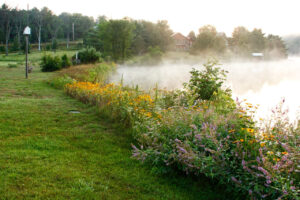
Natural Shoreline
Natural shorelines use native vegetation and gentle slopes to stabilize banks and absorb wave energy. Unlike hardened shorelines, such as concrete walls or riprap, natural shorelines slow water movement, reduce erosion, and allow floodwaters to spread and dissipate energy more gradually (Huang et al., 2020). In lake and river-dominated regions, restoring natural shorelines can help buffer against flooding and fluctuating water levels while providing habitat for aquatic and terrestrial species.
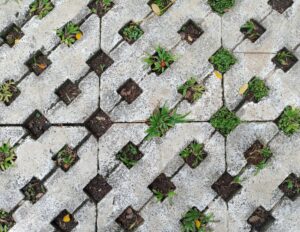
Permeable Pavement
Permeable pavement allows rainwater to infiltrate through surfaces such as parking lots, sidewalks, and low-traffic roads, reducing surface runoff and peak storm flows. These systems store water temporarily in an underlying gravel layer before allowing it to infiltrate into the soil or drain slowly. Replacing impervious surfaces with permeable pavement can significantly reduce pluvial flooding in urban areas and improve groundwater recharge (Huang et al., 2020).
Bioswales
Bioswales are vegetated, shallow channels designed to slow and filter stormwater runoff. Typically planted with deep-rooted native vegetation, bioswales enhance infiltration and trap sediments and pollutants before runoff enters storm sewers or nearby water bodies (Huang et al., 2020). In urban settings, bioswales are often integrated along roadsides or parking areas, helping to reduce downstream flooding while improving urban green space (NVCA, n.d.).
Rain gardens
Rain gardens are landscaped depressions that collect runoff from urban areas, allowing water to soak into the ground rather than flow directly into storm drains or nearby waterways. These features are particularly effective during small to moderate rainfall events, which make up the majority of storms in places like Ontario (Quagliolo et al., 2023). Rain gardens not only reduce runoff volume but also improve water quality and urban biodiversity, making them a multifaceted flood mitigation tool (Huang et al., 2020).
Rain barrels
Rain barrels capture and store roof runoff for later use, such as lawn and garden watering. While smaller in scale, rain barrels can collectively reduce runoff volumes during heavy rainfall events when adopted across neighbourhoods.
For more information on the topic of water scarcity and flooding, check out our Flooding and Water Scarcity page and feel free to share this information!
References
Huang, Y., Tian, Z., Ke, Q., Liu, J., Irannezhad, M., Fan, D., … & Sun, L. (2020). Nature‐based solutions for urban pluvial flood risk management. Wiley Interdisciplinary Reviews: Water, 7(3), e1421.
Moghal, Z., & Peddle, S. (2016). At the front lines of flood: How prepared are Ontario communities. Retrieved from: https://uwaterloo. ca/partners-for-action/sites/ca.partners-foraction/files/uploads/files/p4a_front_lines_of_the_flood_04jul16.pdf.
Government of Canada. (2025, September 12). Get prepared. https://www.canada.ca/en/services/policing/emergencies/preparedness/get-prepared.html
Government of Ontario. (2020). Ontario flooding strategy: Protecting people and property. Ministry of Natural Resources and Forestry. https://www.ontario.ca/page/protecting-people-property-ontarios-flooding-strategy
Nottawasaga Valley Conservation Authority. Low Impact Development (LID). https://www.nvca.on.ca/low-impact-development/
Quagliolo, C., Roebeling, P., Matos, F., Pezzoli, A., & Comino, E. (2023). Pluvial flood adaptation using nature-based solutions: an integrated biophysical-economic assessment. Science of The Total Environment, 902, 166202.
This resource is part of an education toolkit generously funded by: