
by Christopher Dennison, Municipal Policy Intern
In a previous blog, we highlighted the paradox between persistent unsustainable land-use practices and the general desire among shoreline property owners for conserving water quality. In this blog, we will continue the discussion and explore the ways in which organizations and governments can spur pro-environmental action for the betterment of shoreline property owners and aquatic ecosystems.
Lack of education and awareness are often cited in discussions regarding shoreline issues. In 2020, the British Columbia-based POLIS Project on Ecological Governance conducted a survey of stakeholders regarding their perspective on the state of watershed or water-based issues in the province. When asked what the most persistence challenges or barriers to advancing water / watershed governance were, a lack of education and awareness was cited by the highest proportion (44%) of respondents (Brandes, et al., 2016). This sentiment is shared in other regions of the country: in a 2020-2021 survey of municipal officials, planners, and lake associations, Watersheds Canada found that education and awareness figured prominently in the results on barriers to sustainable land-use across several regions, being the second largest perceived barrier cited by lake associations (Dennison, 2021).
If lack of knowledge is the issue, it stands to reason that the provision of informed shoreline assessments and educational resources could help correct the self-enhancement issue cited in the aforementioned paper, while simultaneously contributing to higher rates of environmental education and awareness. Love Your Lake, a partnership initiative operated by Watersheds Canada and the Canadian Wildlife Federation, has provided 49,753 shoreline assessments to property owners across Canada. Following each assessment, trained technicians provide detailed reports on riparian management specific to each property, giving participants the site-specific information needed to voluntarily improve the quality of their shoreline while also educating landowners on the importance of naturalization efforts. Similar programs such as The Natural Edge actively aid in the naturalization of shoreline properties through site-specific planning and the planting of native trees, shrubs, and wildflowers. Since its inception, The Natural Edge has restored more that 368,500 m2 of shoreline across Canada, all while spreading awareness about freshwater issues to Canadian property owners and policymakers.
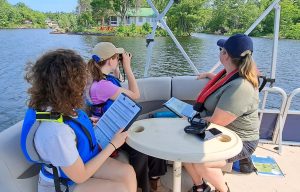
Trained Love Your Lake technicians fill in a peer-reviewed data sheet for each waterfront property on a lake, leading to site-specific reports for waterfront landowners to use to take action.
Participation in environmental outreach campaigns or stewardship programs has been shown to predict modest increases in sustainable land-use practices on the part of important stakeholder groups, including farmers (Goodale et al., 2015) and lakeshore property owners (Touw, 2021). However, participation does not necessarily involve a complete shift in behaviour. After participating in educational stewardship programs, participants in the two aforementioned studies did initiate (or planned to initiate) some but not all recommended stewardship actions on their private lands.
After participation in Love Your Lake, for example, many landowners stated that they had completed or would be more willing to complete certain pro-environmental shoreline actions after taking part in the program, including planting native trees and shrubs, leaving natural aquatic vegetation, and maintaining woody debris on the shoreline. However, other activities, such as curtailing the use of fertilizer, not mowing lawns and softening retaining walls, were met with less positive reception (Touw, 2021). Of 2,757 program participants of Love Your Lake, close to 50% reported that they were not interested in participating in stewardship activities on their lake. Barriers to participation in these stewardship activities included: a lack of time, a lack of information, stewardship not being a priority, and cost (Watersheds Canada, 2021; Touw, 2021).
Regardless of their participation in educational stewardship programs, significant barriers to action remain for many shoreline landowners. Perhaps the link between environmental education and environmental action is not as simple or direct?
Recent psychological studies into the linkage between education and environmental action have argued against a linear model of environmental behaviour (Ardoin, Bowers, Gaillard, 2019). Specifically, scholars have challenged what are known as “information deficit models” of behaviour (see Burgess et al., 1998), which:
“[assume] that educating people about environmental issues […] automatically result in more pro-environmental behaviour” (Kollmuss & Agyeman, 2002, p. 241).
According to Ardoin, Bowers, and Gaillard (2019):
“…environmental education has moved away from suggesting a linear path from environmental attitudes to knowledge to action, now emphasizing a dynamic, complex ecosystem of relationships that influence behavior rather than earlier ideas derived from an information-deficit perspective” (p. 2).
Furthermore, according to Green et al. (2019):
“…researchers continue to demonstrate that providing knowledge and awareness is insufficient to achieve pro-environmental outcomes, even when those outcomes may be beneficial to the individual” (p. 70).
Based on this research, changing unsustainable shoreline practices is likely more nuanced than the information-deficit model. Practitioners or organizations should not assume that participation in stewardship campaigns or receiving educational materials alone will facilitate shifts in environmental action when a complex ecosystem of barriers persist. Many scholars have argued that more pragmatic approaches, such as collaborative social marketing campaigns that target an array of variables, namely barriers to action, are more effective in modifying behaviour:
“Unlike many information-intensive campaigns, community-based social marketing has been shown to have a much greater probability of promoting sustainable behavior […] Its effectiveness is due to its pragmatic approach, which involves the following steps: carefully selecting an activity to be promoted; identifying barriers to the activity; designing a strategy to overcome these barriers, when possible; piloting the strategy with a small segment of a community; and, finally, evaluating the impact of the program once it has been implemented across a community” (McKenzie-Mohr, 2000).
Cost and lack of time are two predominant barriers to shoreline naturalization efforts, as evidenced during previously mentioned surveys. Effectively mitigating shoreline degradation, according to the highly cited community-based social marketing strategy, will necessitate reducing or eliminating these barriers.
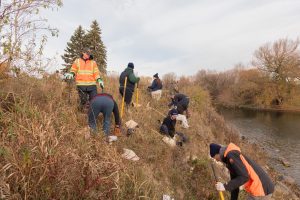
Initiatives like community plantings combine education and action and have a greater opportunity to impact people’s views. (Photo: Stephany Hildebrand)
The Natural Edge is a program that offers subsidized rates for property owners living on the shores of lakes and rivers in Canada, and also accommodates the busy schedules of property owners through collaborative management of site-planning, plant orders, planting tools, and physical installation. Taking advantage of the Native Plant Database offered through The Natural Edge, landowners can reduce the time necessary to select appropriate native plants by filtering results to fit the specific needs of their property and the region it occupies. By targeting both barriers to action and educational gaps around shoreline issues, The Natural Edge has reached thousands of shoreline properties across the country, planting over 143,000 native trees, shrubs, and wildflowers that will help improve water quality and support wildlife. In a similar way, programs like Love Your Lake, and Watersheds Canada’s Planning For Our Shorelands and Freshwater Stewardship Community all reduce the information, time, and cost-sensitivities that represent barriers to action. Love Your Lake reduces barriers of cost and time through site-specific evaluations and voluntary, non-regulatory recommendations for improving freshwater health for people and wildlife, while Planning For Our Shorelands and Freshwater Stewardship Community remove networking barriers through free, online webinars hosted by experienced land-use planners, environmental scientists, and other professionals from across Canada.
The conservation of natural shoreline ecosystems is at the foundation of protecting the quality of freshwater lakes and rivers in Canada. While unsustainable shoreline practices persist at high rates across the country, many stewardship programs and organizations have sought to educate landowners and raise awareness about the importance of vegetated shorelines for protecting wildlife and protecting water quality.
While important, education cannot be expected to change unsustainable shoreline practices and facilitate pro-environmental action on its own. Equally important are the many barriers to environmental action, including cost and time. Successful initiatives which help shoreline property owners overcome or mitigate barriers to naturalization while simultaneously providing informed educational material should be emulated in future shoreline campaigns. This is not only supported by the psychological and sociological literature on environmental action, but also in practice through highly successful and lauded programs such as The Natural Edge, Love Your Lake, Freshwater Stewardship Community, and Planning For Our Shorelands, which together fill knowledge gaps and help remove barriers to environmental action.
References
Ardoin, N.M, Bowers, A.W., & Gaillard, E. (2019). Environmental education outcomes fro conservation: A systematic review. Biological Conservation, 108224. DOI: 10.1016/j.biocon.2019.108224.
Brandes, O. M., Morris, T., Archer, J., et al. (2016). Illumination: Insights and Perspectives for Building Effective Watershed Governance in B.C. POLIS Water Sustainability Project. https:// poliswaterproject.org/polis-research-publication/illumination-insights-perspectives-building-effective-watershed-governance-b-c/.
Burgess, J., Harrison, C.M., & Filius, P. (1998). Environmental Communication and the Cultural Politics of Environmental Citizenship. Environment and Planning A: Economy and Space, 30(8). https://doi.org/10.1068/a301445.
Dennison, C.J. (2021). The Future of Our Shores: A report on three Stakeholder Surveys …the state of shoreland stewardship and land-use according to Municipal Planners, Councillors, and Lake & River Associations in Ontario… Watersheds Canada. Retrieved from: https://watersheds.ca/pfos-resources/.
Goodale, K., Yoshida, Y., Beazley, K.F., & Sherren, K. (2015). Does stewardship program participation influence Canadian farmer engagement in biodiversity-friendly farming practices? Biodiversity and Conservation. DOI: 10.1007/s10531-015-0872-1.
Green, K.M., Crawford, B.A., Williamson, K.A., & DeWan, A.A. (2019). A Meta-Analysis of Social Marketing Campaigns to Improve Global Conservation Outcomes. Social Marketing Quarterly, 25(1). https://doi.org/10.1177/152450041882425.
Kollmuss, A. & Agyeman, J. (2002). Mind the Gap: Why do people act environmentally and what are the barriers to pro-environmental behavior? Environmental Education Research, 8(3): 239 -260. DOI: 10.1080/13504620220145401.
McKenzie-Mohr, D. (2000). Fostering sustainable behavior through community-based social marketing. American Psychologist, 55(5): 531–537. https://doi.org/10.1037/0003-066X.55.5.531.
Touw, M. (2021). Shoreline Stewardship: Capacity Building through ENGO Programming and Local Partnerships. [Master’s Thesis, Trent University]. Trent University library Digital Collections. Retrieved from: https://digitalcollections.trentu.ca/objects/etd-956.
Watersheds Canada. (2021). Love Your Lake: 2013 – 2012 Summary Report. Retrieved from: https://watersheds.ca/our-work/love-your-lake/.